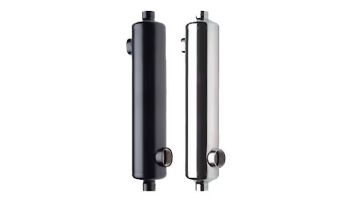
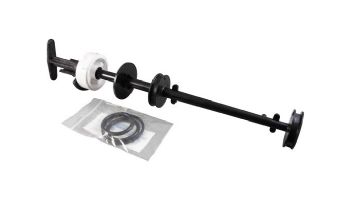
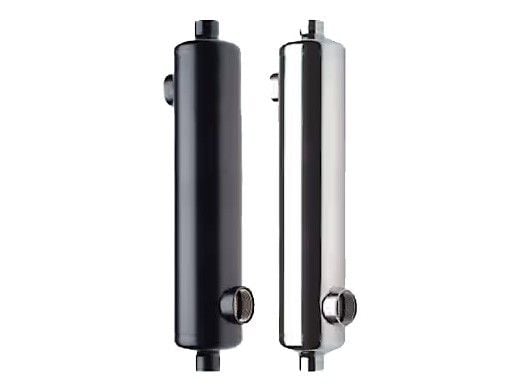
Raypak RP-180 Indirect Heat Exchanger | CR24 Super Alloy High Chorine and Salt 185,000 BTU | Max Flow 80 GPM 16-1/8" L | 018306
$2,097.76
  |
|
|
Indirect Heat Exchangers
For some low-temp applications, a pool heater seems like the obvious choice but really isn't appropriate. For such applications, Raypak recommends instead using a hydronic boiler as the heat engine, with a stainless steel indirect heat exchanger to transfer the heat to the pool without compromising either the water chemistry or the boiler heat exchanger.
For some low-temp applications, a pool heater seems like the obvious choice but really isn't appropriate. For example, the extreme salinity of sea-water pools damages the heat exchanger, and marine life is sensitive to the copper ions which will gradually be released by the heat exchanger. For such applications, Raypak recommends instead using a hydronic boiler as the heat engine, with a stainless steel indirect heat exchanger to transfer the heat to the pool without compromising either the water chemistry or the boiler heat exchanger. These heat exchangers make such a piping system compact and easier to design. Consult the water chemistry table in the manual for details of which alloy to select.
Raypak's titanium (B TI) line of pool heaters are widely used in industrial salt water environments due to its unsurpassed corrosion resistance. Now available from Raypak for the most demanding of applications, from high chlorination to high salt content.
Features:
- Choice of two materials: special treated SS316L or titanium for high chlorine and salt pools
- Efficient design for high flows with low pressure drops
- Available in a wide range of capacities, suitable for heating whirlpools and hot tubs all the way up to large Olympic-size facilities
- Compact structural design allows for a small footprint
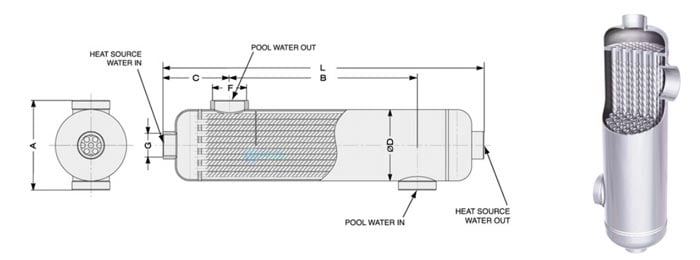
| Pressure |
TEMP ºF (ºC)
|
||
| SS316L | B Ti | ||
| Tube side | 190 PSI | 150 PSI | 406 (208) |
| Shell side | 190 PSI | 150 PSI | 406 (208) |
Brand: Raypak
Raypak RP-180 Indirect Heat Exchanger | CR24 Super Alloy High Chorine and Salt 185,000 BTU | Max Flow 80 GPM 16-1/8" L | 018306
$2,097.76
BTU:
125,000
45,000
125,000
185,000
995,000
Options:
Salt Super Alloy
Salt Super Alloy
Standard
Super Alloy
Platinum Preferred Manufacturer
Product description
Features and details
Specifications
Resources

Warranty

HABLAMOS ESPAÑOL
OPEN 6 DAYS A WEEK
Phone Support (Central Time)
6am - 6pm Monday - Saturday
6am - 6pm Monday - Saturday
NEWSLETTER
COMPANY
ABOUT US
CONTACT US
CONTACTO
CUSTOMER REVIEWS
FAQ
HOURS OF OPERATION
PRIVACY
SITE MAP
TESTIMONIALS
ABOUT US
CONTACT US
CONTACTO
CUSTOMER REVIEWS
FAQ
HOURS OF OPERATION
PRIVACY
SITE MAP
TESTIMONIALS
MY ACCOUNT
RETURN MERCHANDISE
PROMOTIONS
COUPONS
SALES
REBATES
NEWSLETTER
BREAD FINANCING
PROTECTION PLANS
RETURN MERCHANDISE
PROMOTIONS
COUPONS
SALES
REBATES
NEWSLETTER
BREAD FINANCING
PROTECTION PLANS
TERMS
INTERNATIONAL ORDERS
LOYALTY POINTS TERMS
RETURNS POLICY
SHIPPING POLICY
RESOURCES
BLOG
PRODUCT MANUALS
INTERNATIONAL ORDERS
LOYALTY POINTS TERMS
RETURNS POLICY
SHIPPING POLICY
RESOURCES
BLOG
PRODUCT MANUALS



v1.0.3p